Preventing fire with a Scope 10 inspection
A Scope 10 inspection gives you insight into the risks in your installation, along with concrete recommendations to help prevent fire. We're specialists in SCIOS inspections and carry out Scope 10 inspections for businesses, institutions and building owners throughout the Netherlands.
Scope 10 is the SCIOS certification for inspections according to NTA 8220, the Dutch Technical Agreement for assessing electrical equipment for fire risk. Where an inspection under NEN 3140 mainly looks at the safety of people, NTA 8220 looks at the likelihood of fire. Research shows that a large share of business fires start in the electrical installation or in connected equipment.
When is a Scope 10 inspection needed?
A Scope 10 inspection is not yet a legal requirement, but insurers increasingly require it as a condition for taking out or renewing fire insurance - especially for commercial premises, schools, healthcare facilities and owners' associations (VvEs). A Scope 10 inspection is needed when:
- Your insurer asks for it
- You've recently had a fire safety incident at your business
- You want your installation assessed for fire risk
- Your building is old and may still contain outdated installation parts
A Scope 10 inspection isn't just a formality - it's a considered step towards fire safety and limiting liability.
What's checked during a Scope 10 inspection?
A Scope 10 inspection differs from a Scope 8 PI inspection because the focus isn't primarily on personal safety, but on fire safety. We carry out Scope 10 inspections to the latest SCIOS guidelines, looking at:
- Overloading of circuits and distribution boards
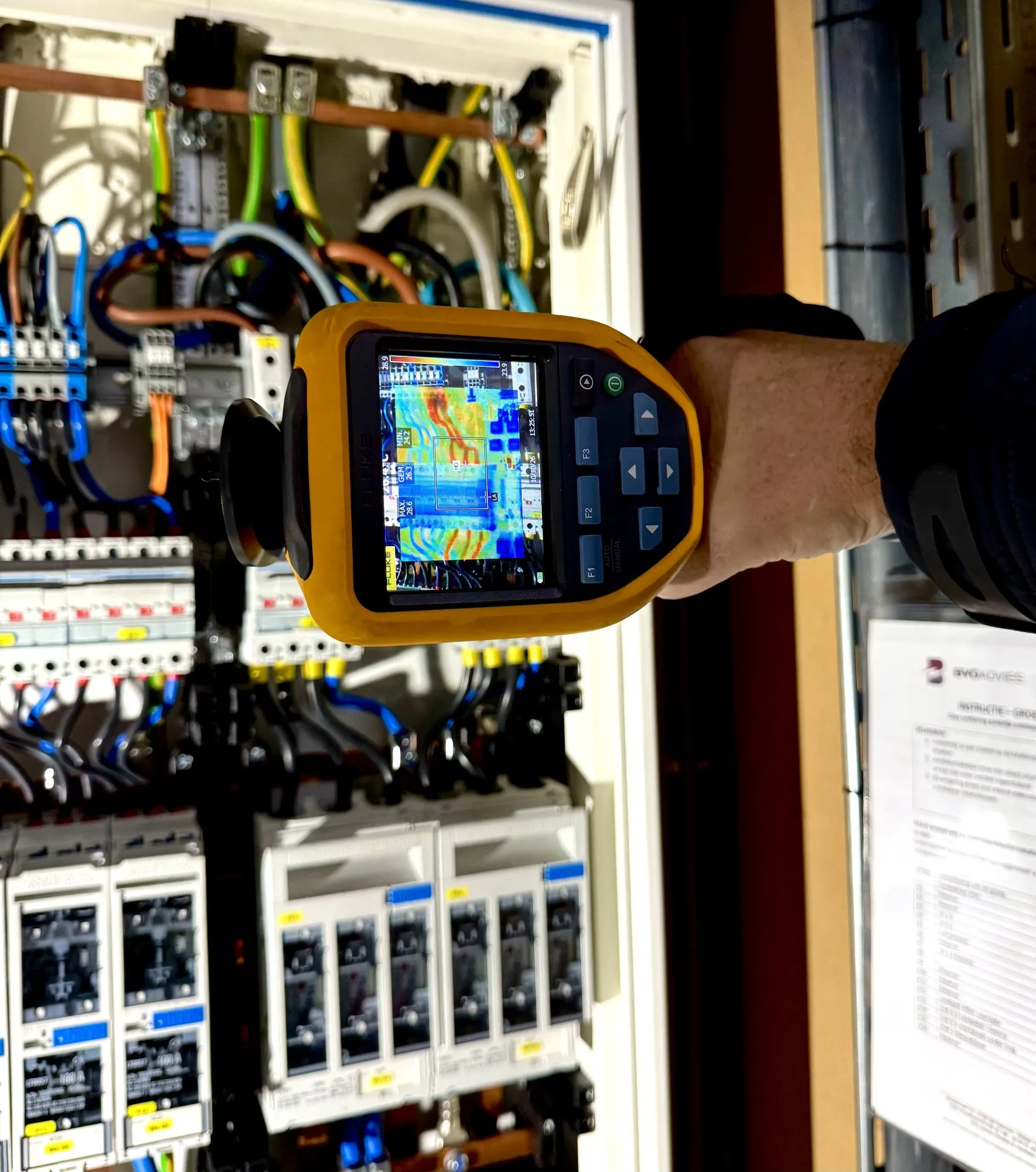
- Thermal imaging to detect hotspots
- Outdated or damaged wiring
- Loose connections or poor contacts
- Unsafely installed equipment
- Connection errors or incorrectly used materials
- Documentation and maintenance condition
You'll receive a clear report listing the findings, including photos and recommendations, so you know exactly where you stand.
Why choose BVo Advies?
SCIOS-certified inspectors
Officially trained and certified, with extensive practical experience and up-to-date knowledge of standards.
Clear communication
A complete, understandable report - clear explanation and practical advice, not technical jargon.
Tailored advice
We think along with you about improvements, replacements or maintenance. Your fire safety comes first.
Transparent pricing
You'll know the cost in advance - clear agreements and fair rates, no surprises afterwards.
Cost of a Scope 10 inspection
The cost of a Scope 10 inspection depends on factors including the size and complexity of your installation, the number of distribution boards, and the location and accessibility of your building. You'll always receive a tailored quote, so you know exactly where you stand in advance.
View our Scope 8 (PI) & 10 SCIOS certificate (PDF) Kiwa SCIOS certified - check our Scope 8 (PI) & 10 certificate in the Kiwa register
Scope 10 and thermographic inspection
An important part of the Scope 10 inspection is the thermographic survey. Using infrared imaging, we can detect warm spots in the installation that are invisible to the naked eye. These "hotspots" often point to poor connections, overloading or wear - all fire risks. Our inspectors are certified to carry out thermographic analysis and use modern equipment to measure accurately and safely. These images are included in the report as visual evidence of your installation's condition.
What happens after the inspection?
After the Scope 10 inspection, you'll receive from us:
- A complete inspection report, including findings, photos and recommendations
- A report suitable for your insurer
- Advice on possible next steps or adjustments to your installation
Common questions about Scope 10
What does a Scope 10 inspection look for specifically?
Do insurers require a Scope 10 inspection?
Can Scope 10 and Scope 8 PI be combined?
What is NTA 8220?
How often is a Scope 10 inspection needed?
Is a Scope 10 inspection a legal requirement?
What does a Scope 10 inspection cost?
Where does BVo Advies carry out Scope 10 inspections?
Ready for certainty about the fire safety of your electrical installation?
Get in touch with BVo Advies for a Scope 10 inspection. We work throughout South Netherlands, including Breda, Den Bosch, Deurne, Helmond, Oss, Tilburg, Valkenswaard, Veghel and Weert.
Request an inspection